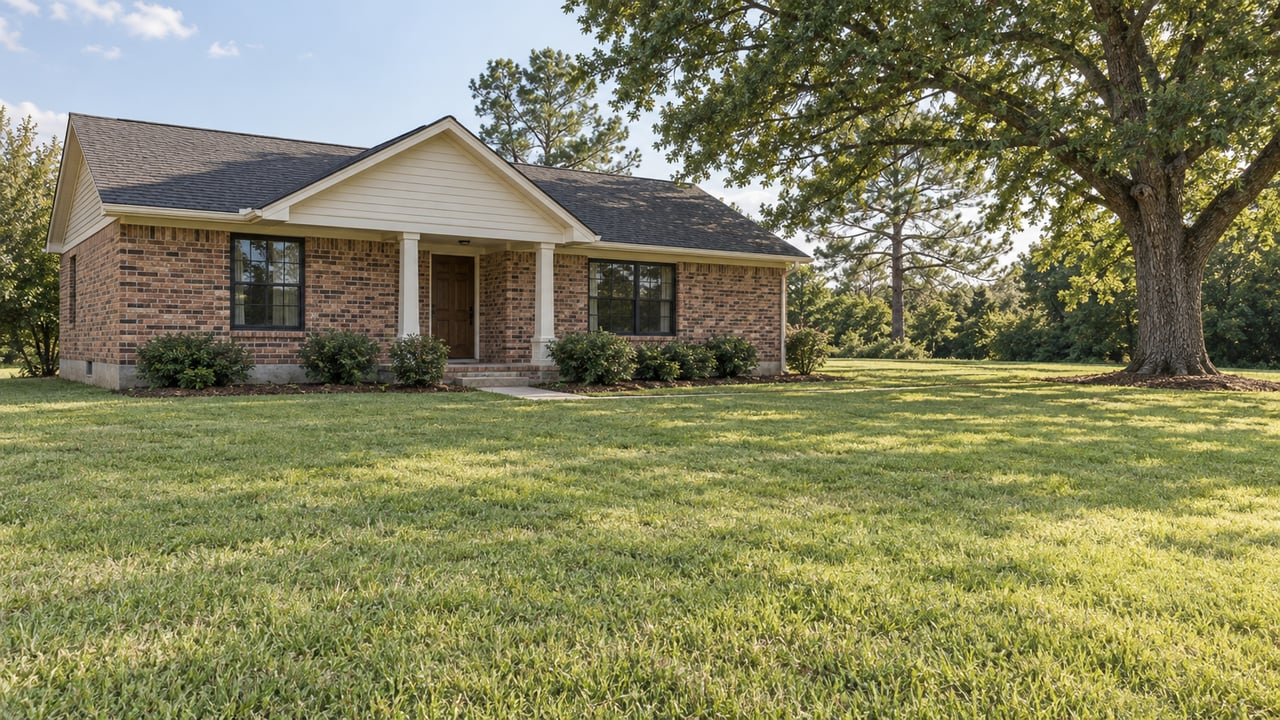
A one-acre lot on one street in Caledonia and a one-acre lot three streets over can list for nearly the same price, use nearly the same language about school-zone access and country quiet, and still put a buyer on two completely different timelines to get a house built. The difference has nothing to do with square footage or soil quality. It comes down to a boundary that never shows up in the listing photos: whether that parcel sits inside the actual Town of Caledonia or in unincorporated Lowndes County.
Caledonia, Mississippi is a town of about 1,135 people as of the 2020 census, settled in the 1820s northeast of Columbus by families with Scots-Irish roots. It's small enough that most people talk about "Caledonia" as one place. But the town's legal boundary and the school-district boundary that draws so many buyers here are not the same line, and the gap between them is exactly where a land purchase gets complicated.
One Address, Two Governments
Inside the actual town limits, a buyer works with Town of Caledonia permitting and, where lines already run, connects to municipal water and sewer through the Caledonia Water and Sewer Department. Step outside that boundary into unincorporated Lowndes County, and the same parcel falls under the Lowndes County Unified Land Development Code instead, which sets its own zoning, access, subdivision, and floodplain rules. A buyer eyeing a county parcel is generally advised to request a zoning verification letter from the county planning office and confirm whether any overlay districts affect height, lighting, or noise before writing an offer.
None of this shows up on a portal listing. It shows up when a buyer calls to schedule a perc test and finds out which office to call in the first place.
What Happens When There's No City Sewer Line
If a lot sits outside municipal service, wastewater becomes the buyer's problem to solve, not the town's. Mississippi's rules govern that process statewide. A high water table or marginal soil can push a buyer toward a more expensive system than a quick drive-by would suggest, which is why the standard advice is to build that evaluation into the purchase contract as a contingency rather than assuming it after closing.
Water works the same way in reverse. Where public water doesn't reach, a licensed driller estimates depth, likely yield, and treatment needs before a buyer knows what a private well will actually cost, and that number moves with local geology and water quality rather than following any fixed price list.
None of this is unusual for rural Mississippi. It is unusual for a buyer who assumed "Caledonia" meant one uniform set of utility rules because the town and the surrounding county share a name and a school system.
The Timeline Nobody Puts on the Listing
Put the pieces together and a rough shape emerges. Permitting and utility approvals on a raw lot typically run four to twelve weeks, longer if the parcel triggers floodplain or subdivision review under the county code. Site work and utility installation add several more weeks to a few months. Construction itself, once it starts, generally runs six to twelve months or more, depending on design, weather, and subcontractor availability.
Stack those stages and a buyer moving from a signed contract on a county lot to a finished, move-in-ready home is often looking at close to a year, sometimes more, before anyone unpacks a box. A lot inside town limits with utilities already stubbed to the property line can move noticeably faster, simply because two or three of those early stages shrink or disappear.
Even the Electric Bill Depends on Which Side You're On
The utility question doesn't stop at water and sewer. Electric service in the Caledonia area splits between providers depending on the street, with some parcels served by Monroe County Electric and many county areas served by 4-County Electric Power Association. Natural gas inside town reach runs through the Caledonia Natural Gas District, which fields calls about main proximity and tap fees directly. None of these providers overlap perfectly with the town/county line, which is one more reason the practical advice is the same every time: call and confirm for the specific parcel rather than assuming coverage based on a neighbor's address.
What the Land Itself Is Actually Selling
The Caledonia land market reflects this same split in what buyers are actually shopping for. Some of what's on the market right now is finished product in established subdivisions like Riverstone, where a buyer closes on a completed home with a fenced yard and a set list price. Other listings are new-construction acreage lots, including duplexes recently built along Seed Tick Road, marketed on the promise of space and privacy a couple of miles from Caledonia's schools. These are not competing products so much as different stages of the same pipeline. One buyer is purchasing a finished result. The other is purchasing a timeline, a builder contract, and everything described above.
As of March 2026, active listings across Caledonia carried a median list price near $299,900, with most homes priced from the high $200,000s to the mid $300,000s and inventory tight enough that only around two dozen to thirty homes were on the market at any given time. That price band sits above nearby Columbus, and it's the acreage and the school-zone address doing most of that work, not square footage alone.
Financing Follows the Same Split
Raw land and finished homes aren't just different building projects. They're different loan products. A land-only loan, used to buy the lot itself before construction, typically carries a higher rate and larger down payment than a standard mortgage, and a lender may require a fresh survey and cap the loan-to-value ratio. A construction-to-permanent loan bundles the build into a single loan that funds draws and then converts to a long-term mortgage once the house is finished, but it requires a signed builder contract and an itemized budget and schedule up front. In eligible rural areas, USDA Rural Development programs can help finance land and a new build together, though eligibility and disbursement details are worth confirming with a local lender before a buyer counts on that option.
A buyer who assumes one mortgage conversation covers the whole purchase, from bare lot to finished house, is usually the same buyer who gets surprised by a lender's second set of questions three weeks into the process.
Questions Worth Asking Before an Offer
A few questions settle most of this before it becomes a problem:
- Does this specific parcel sit inside the Town of Caledonia or in unincorporated Lowndes County, and has that been confirmed with the relevant planning office rather than assumed from the address?
- Is municipal water and sewer already run to the lot, or will this require a septic evaluation and possibly a private well?
- Which electric cooperative serves this exact street, and has the natural gas provider confirmed main proximity and tap fees?
- What loan product fits this purchase: a land-only loan, a construction-to-permanent loan, or a USDA Rural Development program, and does the timeline in the builder contract match what the lender expects?
- Has a septic or well contingency been written into the purchase contract, so feasibility gets confirmed before the buyer is locked in?
None of these questions show up in a listing description. All of them show up in a closing timeline.
Caledonia's draw isn't complicated. Buyers want the school district, the acreage, and the quiet that comes with both. What's complicated is that the line between "quick close" and "twelve-month build" runs through the middle of that same small town, invisible on a map and decisive on a calendar. If you're comparing land in Caledonia and want to know which side of that line a specific parcel falls on before you write an offer, Will Sanders and the Sanders Real Estate Group can help you ask the right office the right question the first time.
This article is general information, not legal, tax or financial advice. Consult a qualified professional about your situation.